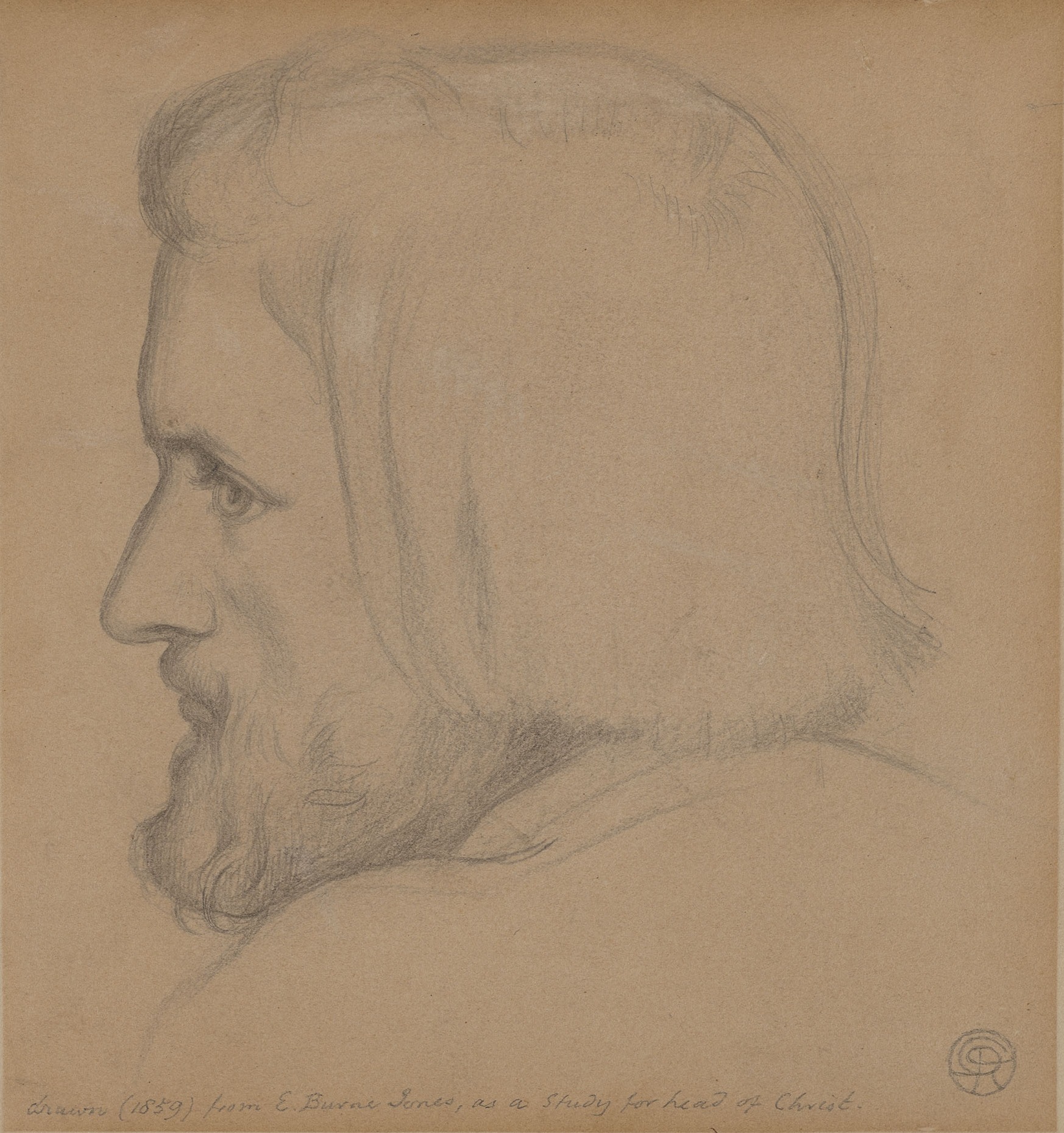
This incisive drawing is a remarkable ad vivum study of the young Edward Burne-Jones made by Dante Gabriel Rossetti. This study was completed in preparation for one of Rossetti’s most important and remarkable finished drawings, Mary Magdalene at the Door of Simon the Pharisee now in the collection of the Fitzwilliam Museum, Cambridge. Drawn in 1859, Rossetti records on the drawing that Burne-Jones was the model for the profile head of Christ in the finished work. Burne-Jones was a great admirer of the older Rossetti, publishing a lavish tribute to Rossetti’s illustrations of William Allingham’s Maids of Elfen-Mere in the Oxford and Cambridge Magazine in 1856. As a result, Burne-Jones and Rossetti became great friends, the younger artist introducing Rossetti to William Morris. In this sensitive drawing, Rossetti captures the intense expression of the young Burne-Jones, producing a powerful testament to their friendship and remarkable record of the personal and professional ties of Pre-Raphaelitism.
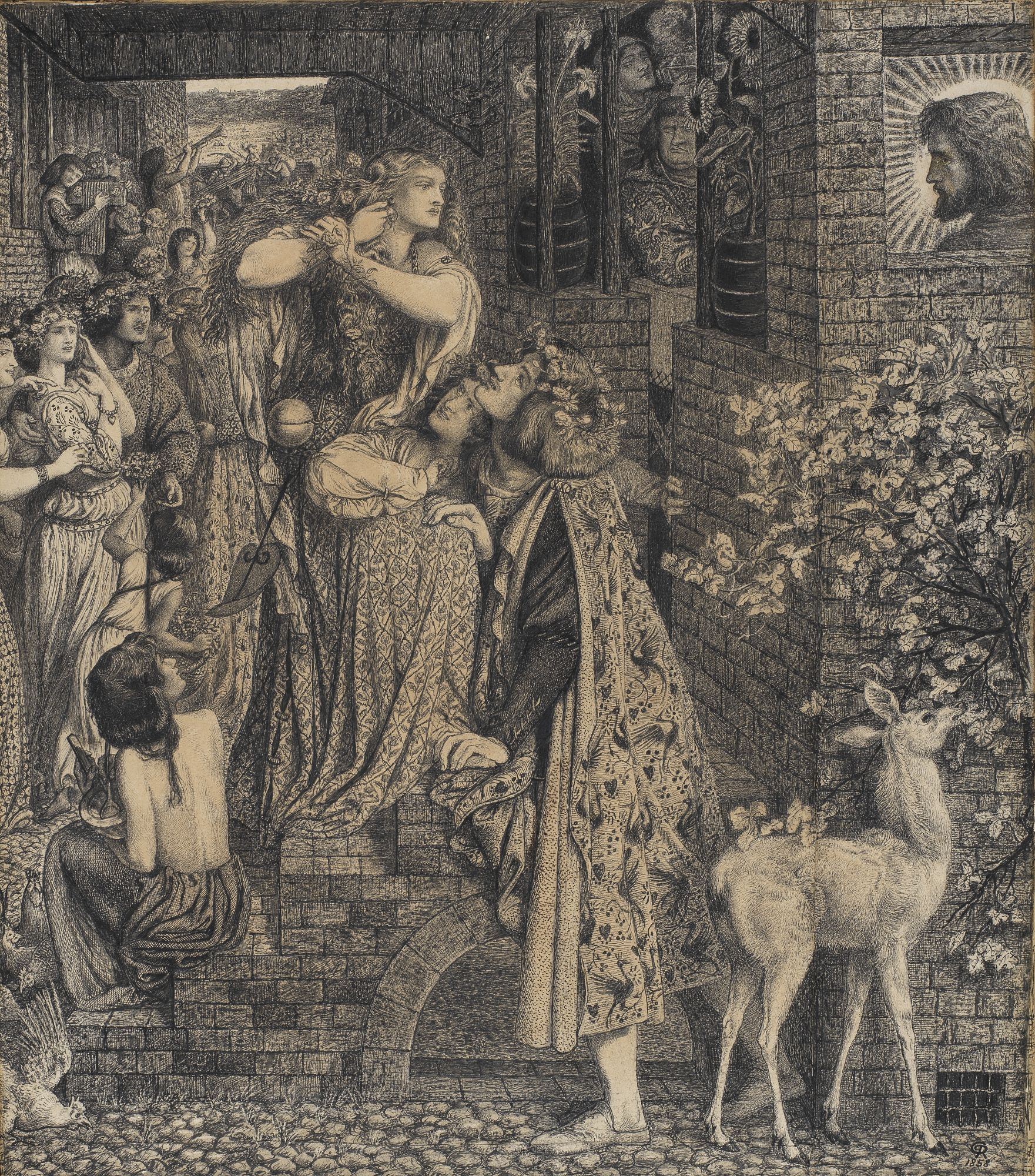
Dante Gabriel Rossetti
Mary Magdalene at the Door of Simon the Pharisee
Pen and Indian ink on paper mounted on fine linen on a stretcher
20 x 18 inches; 508 x 457 mm
Drawn in 1858
Photograph © The Fitzwilliam Museum, University of Cambridge
In 1855 Rossetti published a series of illustrations to The Maids of Elfen-Mere for a poem by his friend William Allingham. The designs demonstrate Rossetti’s sophisticated and evolving response to medieval art and were enormously admired by contemporaries. Rossetti’s vision of Arthurian romance particularly inspired William Morris and Edward Burne-Jones. Neither had met Rossetti when they recruited him as a contributor to their Oxford and Cambridge Magazine which Morris founded in 1856 to promote his ideas about art and poetry. In February 1857, Rossetti wrote to William Bell Scott:
‘Two young men, projects of the Oxford and Cambridge Magazine, have recently come up to town from Oxford, and are now very intimate friends of mine. Their names are Morris and Jones. They have turned artists instead of taking up any other career to which the university generally leads, and both are men of real genius. Jones’s designs are marvels of finish and imaginative detail, unequalled by anything unless perhaps Albert Durer’s finest works.’
That summer Morris and Rossetti visited Oxford, being given the commission to paint the upper walls of the Oxford Union’s debating-hall with scenes from Le Morte d’Arthur and to decorate the roof between the open timbers. A roster of young painters were recruited to help complete the project along with two local models, Bessie and Jane Burden, the latter would go on to marry Morris in 1859, before becoming Rossetti’s muse and mistress.
The present drawing dates from this febrile, productive moment, when Rossetti, Morris and Burne-Jones were collaborating on the decoration of the Oxford Union. Rossetti had begun to prepare the elaborate composition of Mary Magdalene at the Door of Simon the Pharisee in 1853 but the densely worked drawing was not finished until 1859, at which point Rossetti decided to use Burne-Jones as the model for the profile portrait of Christ. The scene depicted was described in detail by Rossetti himself: ‘two houses opposite each other, one that of Simon the Pharisee, where Christ and Simon, with other guests, are seated at table. In the opposite house a great banquet is held, and feasters are trooping to it dressed in cloth of gold and crowned with flowers… Mary Magdalene… has been in the procession, but suddenly turned aside at the sight of Christ, and is pressing forward up the stairs to Simon’s house.’[1] Rossetti had already persuaded the actress Ruth Herbert to sit for the figure of Mary Magdalene writing to William Bell Scott that she: ‘has the most varied and highest expression I ever saw in a woman’s face, besides abundant beauty, golden hair, etc. Did you ever see her? O my eye! She has sat to me now and will sit to me for Mary Magdalene.’[2] Rossetti’s careful, expressive portrait study of Ruth Herbert survives in the collection of the Ashmolean Museum, Oxford. Rossetti evidently decided the youthful, intense and bearded features of Burne-Jones provided the ideal model for Christ. The present assured profile portrait drawing was undoubtedly made from life, Surtees quotes a letter from the novelist George Meredith stating that the architect Philip Webb had actually seen Burne-Jones sit for the drawing.[3] In the finished work, Christ is shown through a window, essentially separated from Mary Magdalene and other revellers. Rossetti relies on the profile design to impart both Christ’s humanity and sympathy, as Rossetti himself explained: ‘Christ looks towards her from within, waiting till she shall reach him.’ The finished drawing was much admired by John Ruskin who was eager to exchange it for a work of St Catherine, which he had already bespoken. He wrote to Rossetti: ‘The Magdalene is magnificent to my mind, in every possible way: it stays by me.’
The present beautifully modelled drawing demonstrates Rossetti’s mastery at observation, whilst the clarity of the line helped enshrine Burne-Jones’s features as a Pre-Raphaelite archetype of Christ. Rossetti would return to this drawing for the design for a stained glass window of The Sermon on the Mount, again using Burne-Jones as the model for Christ.[4]
References
- Pall Mall Budget, 22 January 1891, p.14.
- Virginia Surtees, The Paintings and Drawings of Dante Gabriel Rossetti (1828-1882) A Catalogue Raisonné, Oxford, 1971, vol.I, p.64.
- Virginia Surtees, The Paintings and Drawings of Dante Gabriel Rossetti (1828-1882) A Catalogue Raisonné, Oxford, 1971, vol.I, p.63.