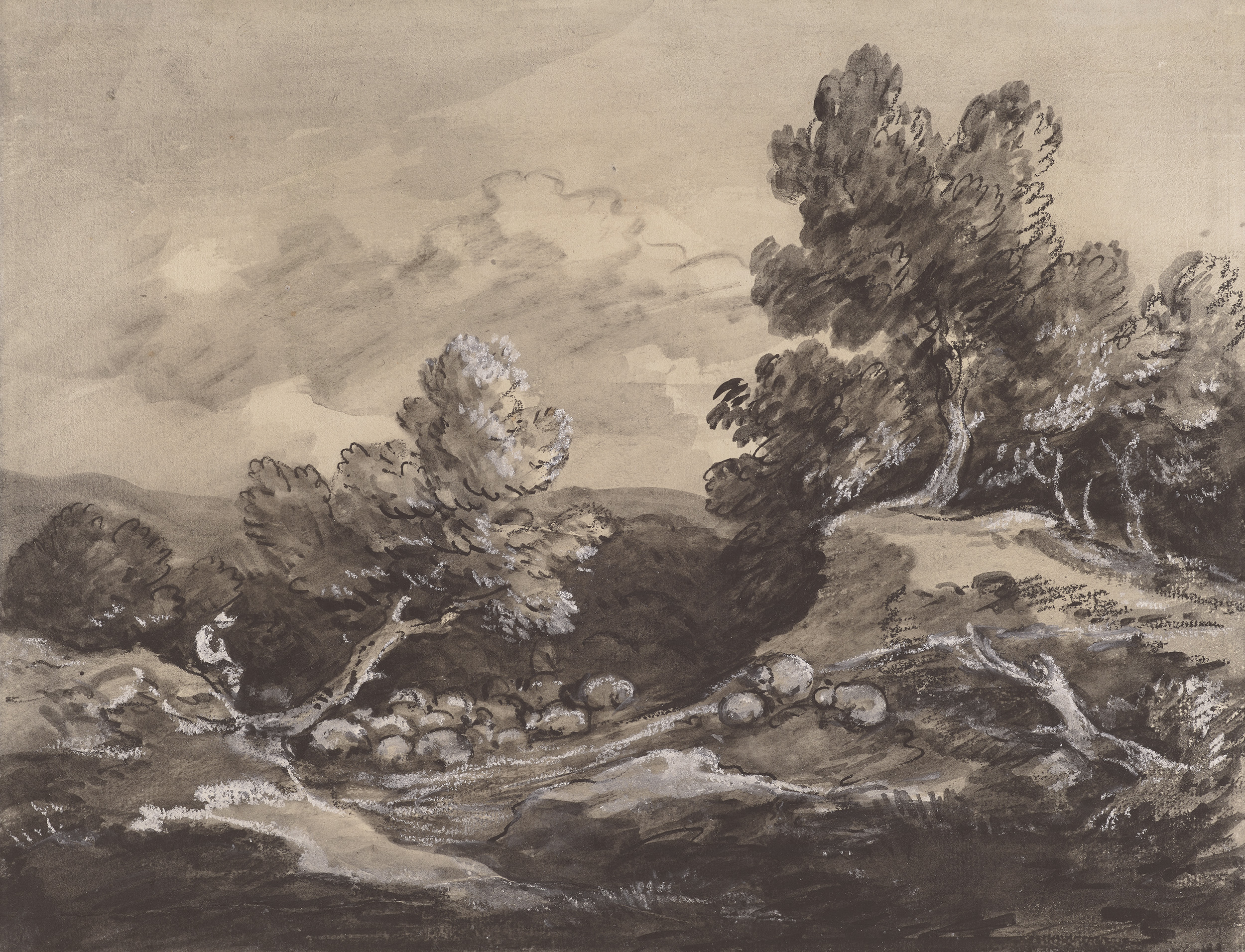
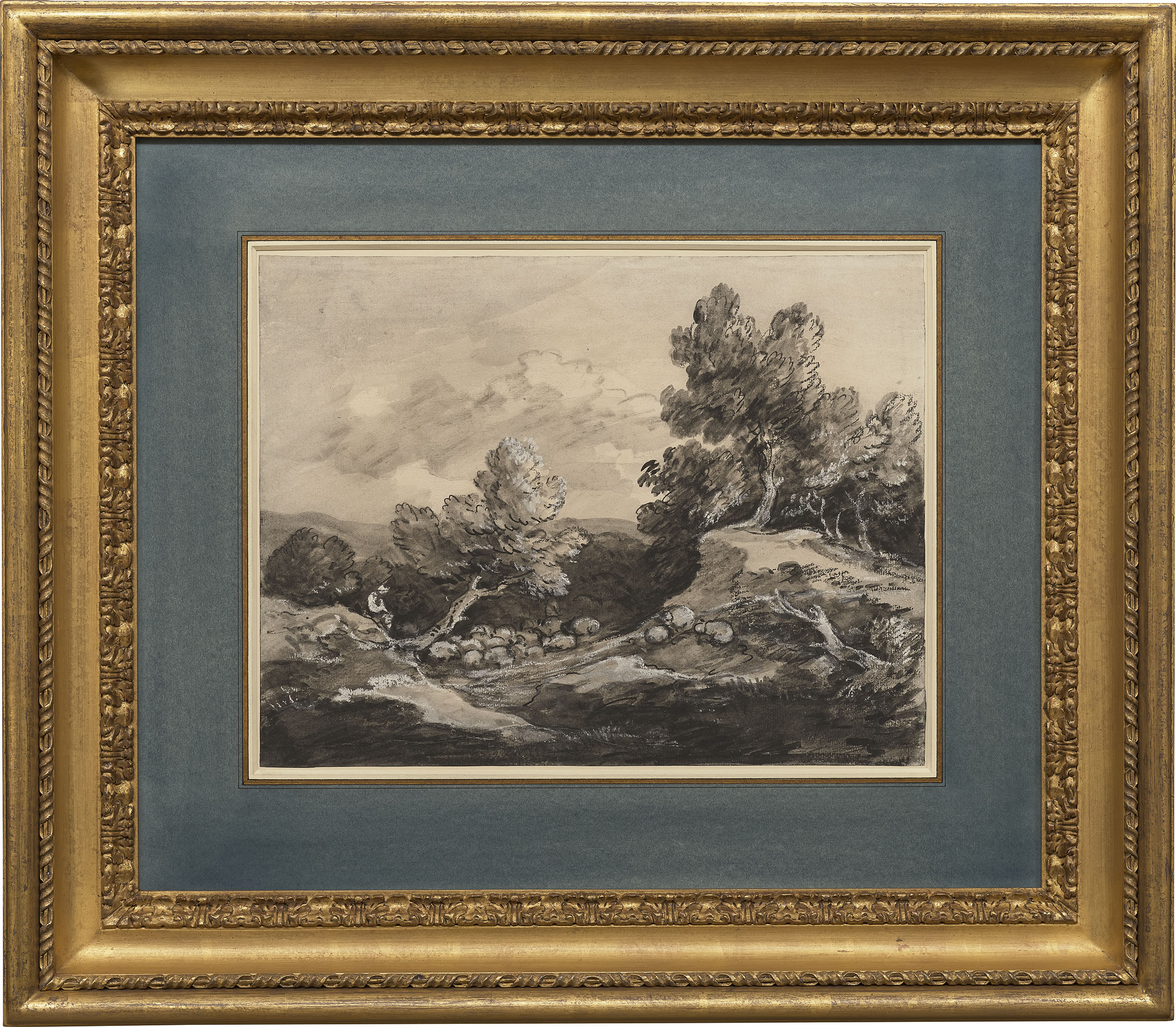
This fluid, late landscape drawing was made by Thomas Gainsborough towards the end of his career. Gainsborough had spent a lifetime refining his mark making, culminating in a remarkable suite of graphically bold, almost abstract images. In this unusually grand and beautifully preserved example, Gainsborough captures a complex composition of trees, bank and distant hills, seated shepherd and sheep with remarkable economy. What makes this sheet particularly remarkable is its early history, first recorded in the collection of John Jeffreys Pratt, 1st Marquess Camden, it is clear Gainsborough did not consider the composition unfinished or insufficiently resolved.
This fluid wash study is a quintessential landscape drawing made by Thomas Gainsborough at the height of his creative powers. Writing in his Anecdotes of Painters published in 1808, Edward Edwards made an important early assessment of Gainsborough’s late landscape drawings:
‘in his latter works, bold effect, great breadth of form, with little variety of parts, united by a judicious management of light and shade, combine to produce a certain degree of solemnity. This solemnity, though striking, is not easily accounted for, when the simplicity of materials is considered, which seldom represent more than a stony bank, with a few trees, a pond, and some distant hills.’[1]
The present sheet perfectly encapsulates these qualities: Gainsborough has simply used grey wash, white and black chalk to create a composition of ‘stony bank’, ‘a few trees’ and a ‘distant hills’ populated by a flock of sheep and a solitary shepherd. The sheet is part of a body of drawings Gainsborough made, which were highly prized by contemporary collectors, presumably precisely because they evoked an emotional response, characterised by Edwards as ‘a certain degree of solemnity.’
The technique used by Gainsborough in drawings like this was also described by Edwards:
‘A process rather capricious, truly deserving the epithet bestowed upon them by a witty lady, who called them moppings. Many of these were in black and white, which colours were applied in the following manner: a small bit of sponge tied to a bit of stick, served as a pencil for the shadows, and a small lump of whiting, held by a pair of tea-tongs was the instrument by which the high lights were applied; beside these there were others in black and white chalks, India ink… with these various materials he struck out a vast number of bold, free sketches of landscape and cattle, all of which have a most captivating effect to the eye of an artist, or connoisseur of real taste.’[2]
In the present sheet, Gainsborough seems to have used a combination of methods to achieve the densely worked effect, probably ‘mopping-in’ certain areas, such as the dense clump of trees on the right, adding highlights to the sheep, trees and seated shepherd.
Gainsborough’s landscapes were never purely topographical and the present sheet demonstrates his interest in deploying a limited vocabulary of visual motifs: sheep, shepherd, trees and hills. Many of Gainsborough’s surviving drawings from this period all feature a similar group of components, rearranged to form new compositions. To achieve these ‘free sketches’ Gainsborough developed a visual short-hand, particularly in his handling of trees, figures and livestock; the latter often appearing in an almost abstract reduction of shapes and lines.
This sheet is typical of Gainsborough’s landscape drawings and raises the question of its appeal to contemporaries. The idealised composition is partly inspired by the work of Gaspard Dughet, whose landscapes would have been familiar to Gainsborough and his contemporaries both in the original and through the medium of engraving. This sensibility was shared by Alexander Cozens and there is growing evidence that Gainsborough, like Cozens, was conscious of the ability for his landscape drawings to suggest certain emotions. Such drawings may also reflect Gainsborough’s practice of constructing models of artificial landscapes. W. H. Pyne wrote that he had ‘more than once sat by him of an evening, and seen him make models, or rather thoughts, for landscapes scenery… He would place cork or coal for his foregrounds, make middle grounds of sand and clay, bushes of mosses and lichens, and set up distant woods of broccoli.’[3] It was the apparent simplicity of his formula, as described by Pyne, which prompted Joshua Reynolds to offer the audience of his fourteenth Discourse a word of caution about Gainsborough’s technique, noting: ‘Like every other technical practice, it seems to me wholly to depend on the general talent of him who uses it… it shows the solicitude and extreme activity which he [Gainsborough] had about everything related to his art; that he wished to have his objects embodied as it were, and distinctly before him.’[4] But there is considerable evidence that contemporaries read something more immediate and emotional in Gainsborough’s drawings. It was the imperceptible feeling of ‘bold effect, great breadth of form’ and ‘solemnity’ described by Edwards which probably explained the emotional appeal of such drawings to Gainsborough’s contemporaries.
The present sheet, one of the grandest and best preserved of Gainsborough’s late landscape drawings, unusually has an eighteenth-century provenance, being first recorded in the collection of Gainsborough’s patron John Jeffreys Pratt, later 1st Marquess Camden. We have no evidence that Gainsborough sold his landscape drawings, they were probably given to a limited number of sympathetic collectors. That they were shared, discussed and admired in the eighteenth century is evinced by the limited but perceptive commentary that survives by his contemporaries. This richly worked sheet stands as one of the most expansive and boldest late drawings by Gainsborough to have survived.

Thomas Gainsborough
Wooded Landscape
Grey and grey-black washes and black and white chalk
on pink washed laid paper
11 x 14 ½ inches; 281 x 369 mm
Drawn c.1780
Private collection, formerly with Lowell Libson & Jonny Yarker Ltd