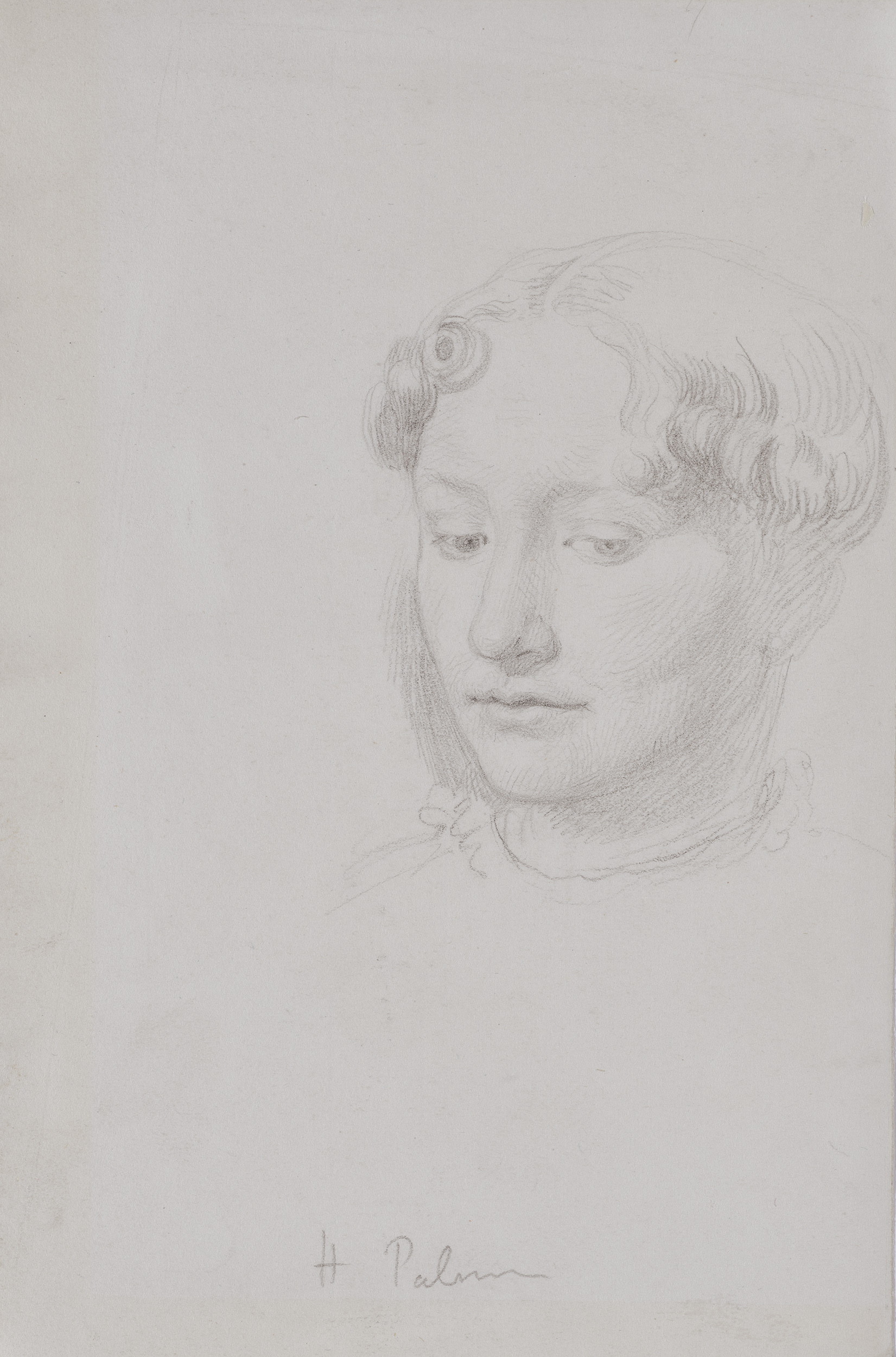
This tender portrait was made by John Linnell and shows his daughter, Hannah shortly after her marriage to the artist Samuel Palmer. Hannah, known in her family as Anny, was 19 when she married Palmer in 1837 and it seems likely that this study was made at that time.Shortly after their marriage, the Palmers set out for Italy with George Richmond and his wife Julia Tatham. In Italy Hannah worked alongside her husband producing a series of landscape drawings, Samuel describing how she made: ‘really consistent, beautiful, and I think saleable drawings from nature.’ This informal drawing is one of only two known likenesses of Hannah to survive.
Palmer was immensely proud of his wife’s artistic attainment, writing from Italy to the Linnells in 1838 of her talent, claiming that: ‘I am sure if she could sell her studies in London for anything like the time and study they have cost it would more than pay her part of the expenses but unless driven to extremity I should like to keep them as it may be impossible that they can be replaced.’[1] Hannah had travelled with two commissions from her father, to paint small-scale copies after Raphael’s frescoes in the Vatican loggia and to colour a set of prints after Michelangelo’s frescoes in the Sistine Chapel. She increasingly worked alongside her husband, working out of doors together and spending her time, when the weather was poor, as she wrote to her parents: ‘in grinding color and replenishing our boxes.’ In April 1838, Hannah showed works in the Rome Exhibition, the following year she is recorded in a cartoon by Penry Williams seated with her husband and a clutch of other international painters working en plein air at La Serpentara in Olevano Romano. Hannah’s surviving works, such as her watercolour of the Street of Tombs, Pompeii, now in the collection of the Chazen Museum of Art, Wisconsin, show how accomplished she had become. Compared with a watercolour of the same view by her husband now in the V&A, London, Hannah’s light filled watercolour is more successful and more compositionally imaginative. On her return to London, Hannah continued to paint and exhibited a sequence of Italian landscapes at the British Institution throughout the 1840s.
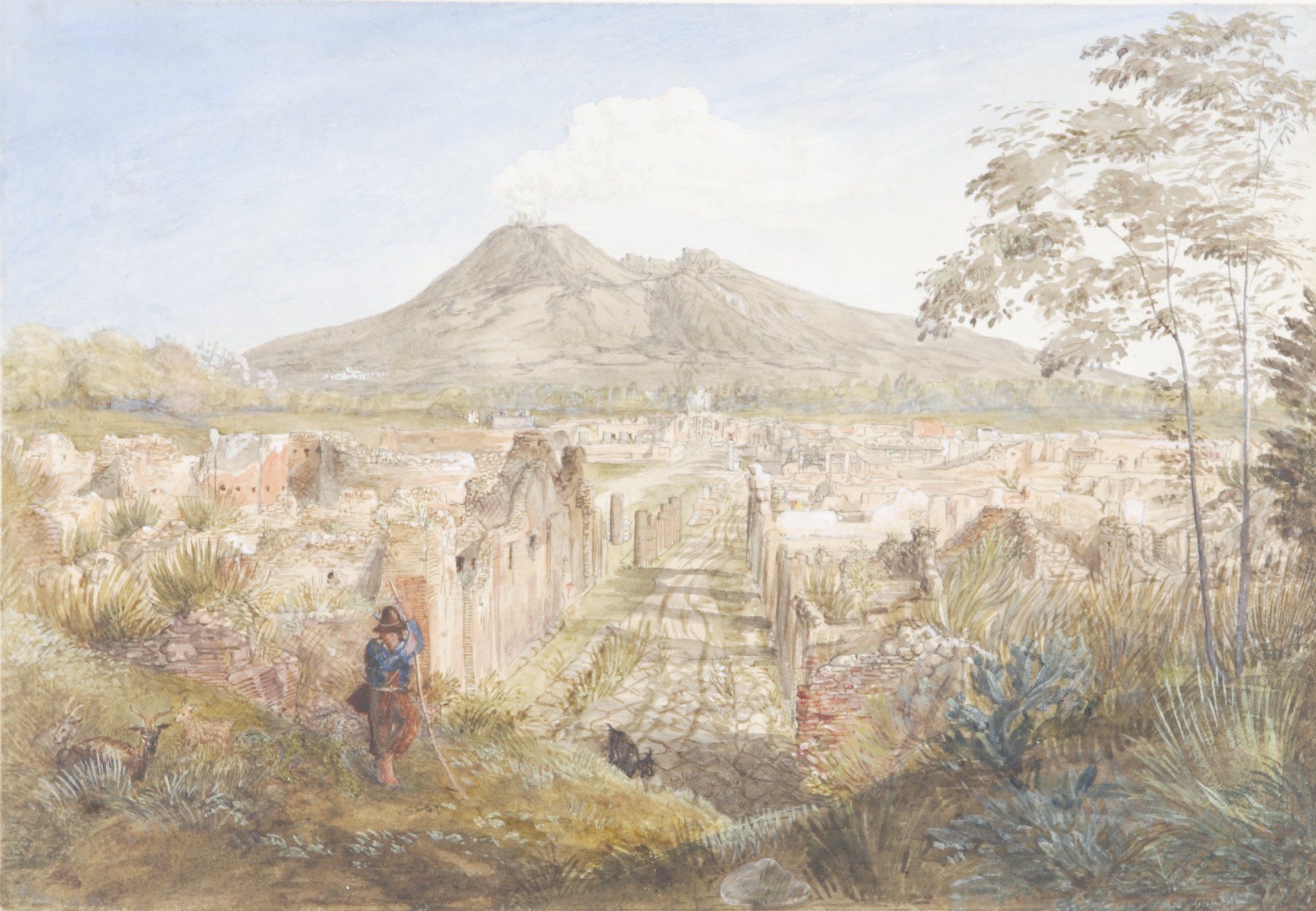
Hannah Palmer
Via delle Scuole, Pompeii, 1838
Graphite, watercolor, and gouache
185 x 267 mm; 7 ¼ x 10 ½ inches
Chazen Museum of Art, University of Wisconsin-Madison, Edward
Blake Blair Endowment Fund and Walter A. and Dorothy Jones
Frautschi Endowment Fund purchase, 2004.30