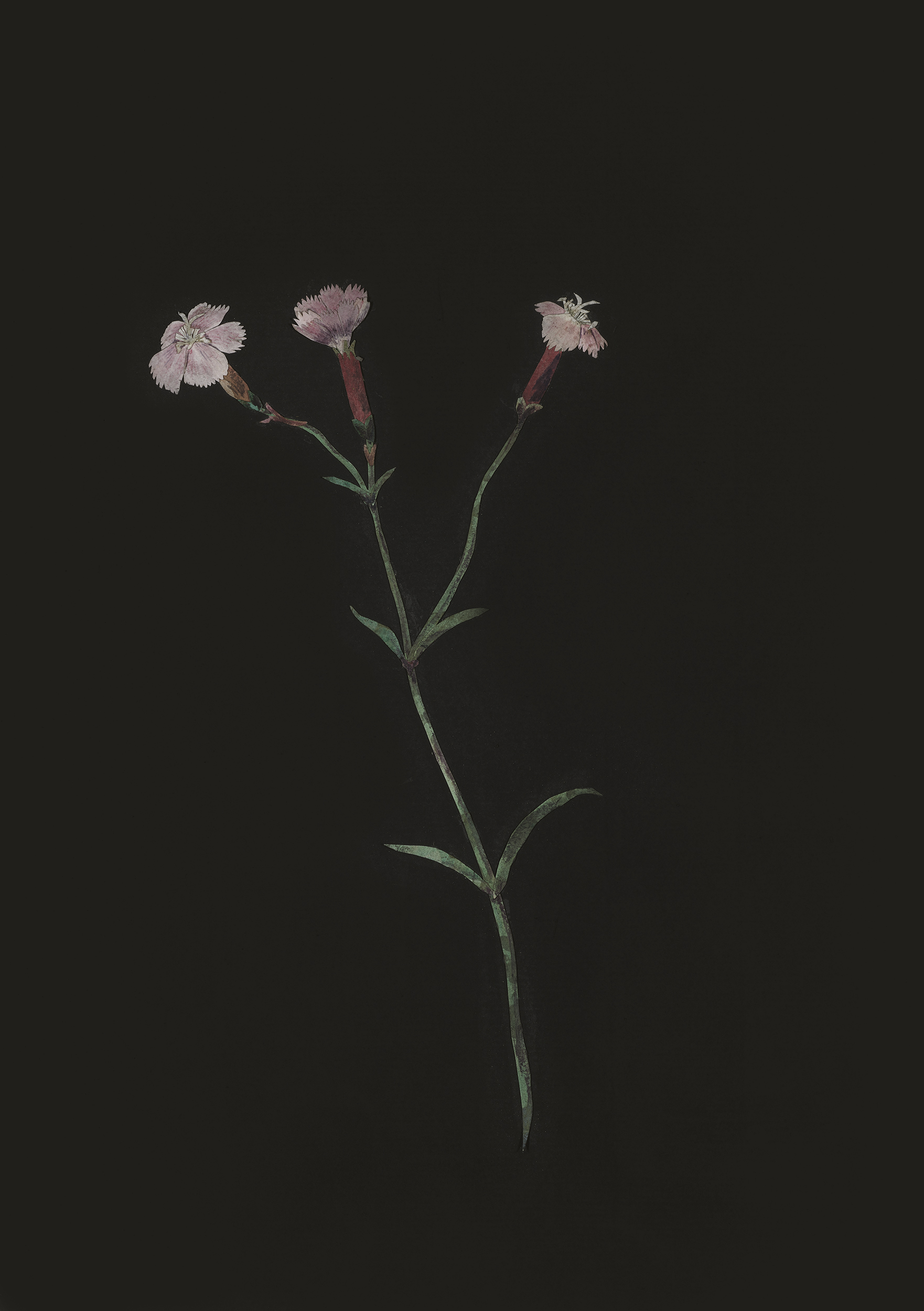
This remarkable paper mosaic was made by the amateur artist Booth Grey, inspired by the botanical collages of his friend Mary Delany. Formerly attributed to Delany herself, this work can be identified as having originated from an album of Grey’s botanical studies which are now principally in the collection of the Yale Center for British Art, New Haven. A younger son of the Earl of Stamford, Booth was a politician and amateur artist of considerable talent who was closely connected to Delany and her circle. The finely wrought collage is made from pieces of cut paper, attached to a backing sheet of black painted paper labelled on the verso with the name of the plant depicted. This singular method of decoupage was developed by Mary Delany in the 1770s, both Delany and Grey produced detailed and botanically accurate depictions of plants, using a range of papers and hand colouring. Delany created a sequence of 985 works which she called ‘paper mosaiks’, collected together in ten volumes, her Flora Delanica is now in the British Museum. Grey’s collage, which was probably made under Delany’s supervision, exemplifies this innovative technique and singular confluence of art and science.
Booth Grey was the son of Harry, 4th earl of Stamford and Lady Mary Booth, heiress to her father, George Booth, 2nd Earl of Warrington. His older brother, George, was married in 1763 to Lady Henrietta Cavendish-Bentinck, daughter of Margaret, Duchess of Portland. By this date the Duchess of Portland had turned her Buckinghamshire house, Bulstrode, into a remarkable museum, forming the largest natural history collection in the country. Bulstrode with its myriad collections and specimens was known as ‘the hive’ for the intense work done by a team of scientists, these included the Swedish botanist, Daniel Solander who was employed as a curator. As Horace Walpole noted: ‘few men have rivalled Margaret Cavendish in the mania of collecting, and perhaps no woman. In an age of great collectors she rivalled the greatest.’ Mary Delany had been an intimate friend of the duchess since their youth and after she was widowed in the 1770s she spent protracted periods at Bulstrode. She began by making her innovative collages from specimens collected by the duchess, but gradually was given unusual or rare plants by others. Delany made collages from four specimens given to her by Booth Grey, these included one in May 1777 and four in April 1779. The specimens from Grey include an Anemone Hortensis that is recorded as coming from ‘Dr Fothergill’s garden’, this implies Booth was sufficiently well-regarded as a plantsman by this date to collect specimens from John Fothergill’s botanic garden at West Ham in Essex. Fothergill had sponsored Sydney Parkinson the first European artist to visit Australia, New Zealand and Tahiti and William Bartram, the American botanist and had one of the most celebrated collections of plants in the country. There is some evidence that Grey was both aware and interested in the correct classification of plants, his own copy of John Hill’s Eden: of A compleat Body of Gardening of 1773 has the plates corrected in Grey’s hand to include their new Linnaean classification.[1]
Grey’s collages show that he was clearly familiar with Delany’s technique. We know Delany had students, including a Miss Jennings: ‘a sensible agreeable, and ingenious woman a pupil of mine in the paper mosaick work’, several of Delany’s late collages are inscribed as having been completed by Jennings. Grey we know was a talented artist, he engraved a series of prints, bound sets of which survive in several collections.[2] The present specimen shows both intimate knowledge of Delany’s innovative technique and remarkable dexterity. The Dianthus is constructed with finely cut pieces of paper, coloured with watercolour and carefully stuck on a sheet of paper painted black. The precision, technique and positioning of the flower on the page all suggest that Grey was taught by Delany herself.
The Grey mosaics were the subject of sustained analysis in preparation for the 2009 exhibition Mary Delany & her circle, held at the Yale Center for British Art. Kohleen Reeder, suggested from the internal evidence that the collages date from the 1790s. Peter Bower found evidence that Grey used many of the same papers as Delany, with several showing an Excise Duty Charge Stamp that dates to before 1786.[3] This raises the possibility that the collages were begun earlier than originally assumed, perhaps as early as April 1779 when Booth presents Delany with four specimens to cut. Mary Delany stopped working on her mosaics in 1784 when her eyesight failed and this may have stimulated Grey to begin cutting his own specimens. Reeder raised doubts about precisely who cut the Grey mosaics, suggesting several hands were at work. This may be the case, but Grey seems likely to be the principal hand. The Yale album is specifically inscribed ’98 plants done by the Honble. Booth Grey’ and there is abundant evidence of Grey’s interest in botany, friendship with plantsmen, artistic accomplishments and close relationship with Delany herself.
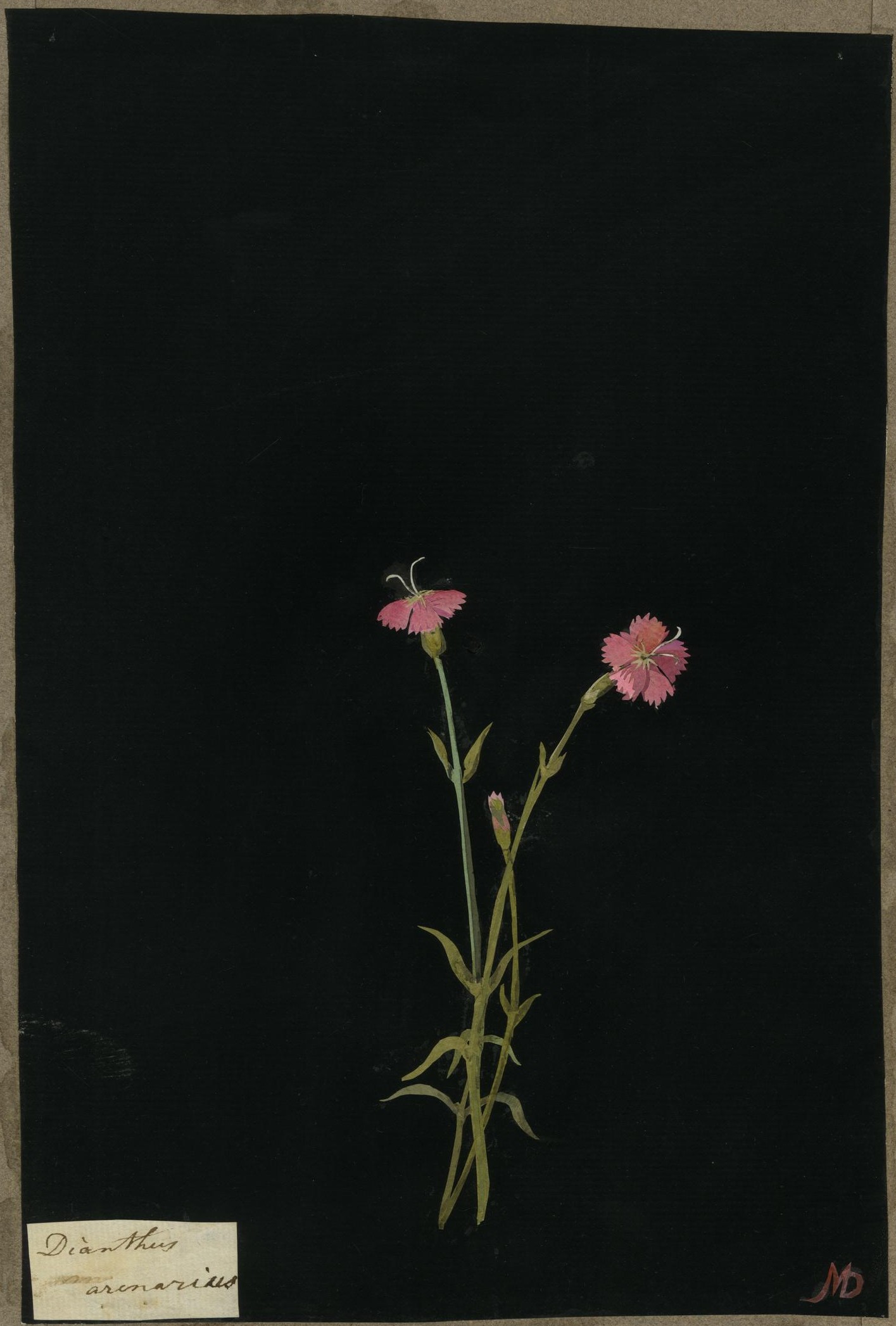
Mary Delany
Dianthus Arenarius, from an album (Vol.III, 79); Cheddar Pink. 1779
Collage of coloured papers, with bodycolour and watercolour, on black ink background
10 ⅞ x 7 ⅛ inches; 276 x 182 mm
© The Trustees of the British Museum
References
- Ed. Mark Laid and Alicia Weisberg-Roberts, Mrs Delany & Her Circle, exh. cat. New Haven (Yale Center for British Art), 2009, p.234, n.12.
- Bound groups of Grey’s engravings survive in the collection of the Lewis Walpole Library, Farmington (Folio 75 A1325754) and Yale Center for British Art, New Haven (Accession number: B1977.14.20049V).
- Ed. Mark Laid and Alicia Weisberg-Roberts, Mrs Delany & Her Circle, exh. cat. New Haven (Yale Center for British Art), 2009, p.240.